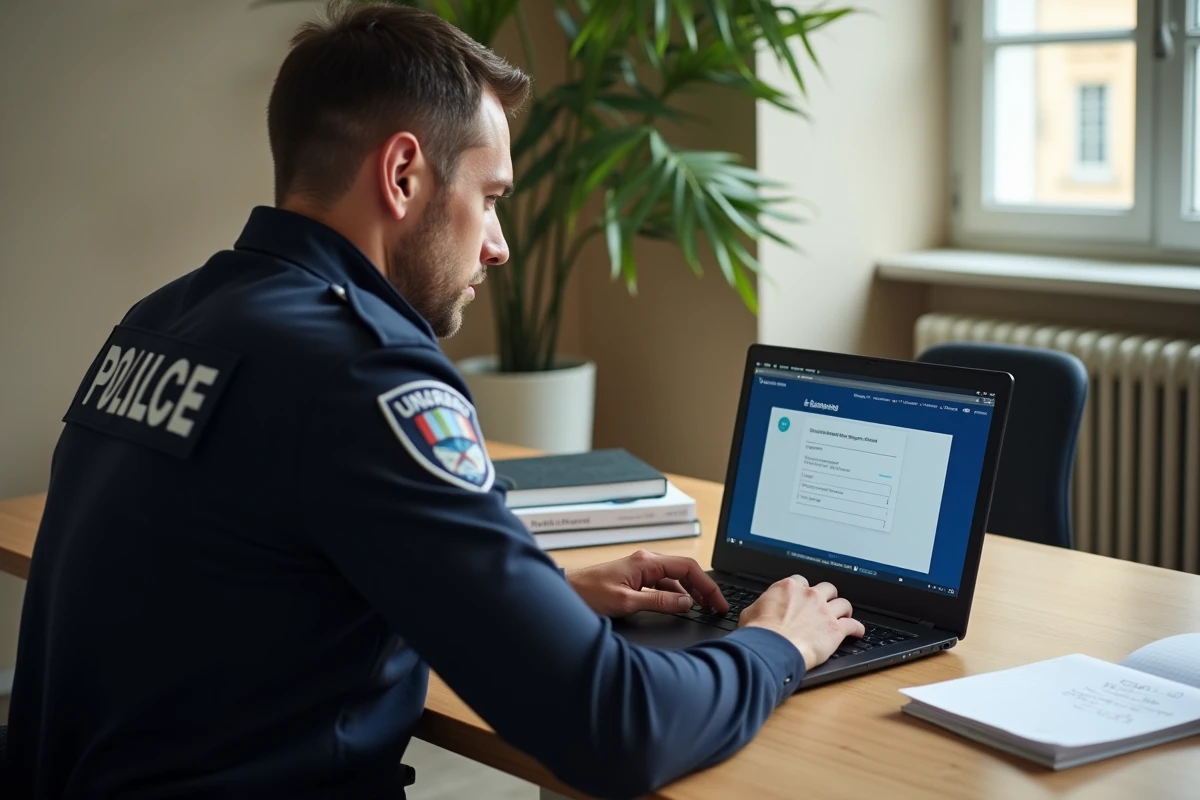
You have just joined the National Police or are preparing for an internal competition, and you are asked to log in to eCampus. The interface is not always intuitive at first glance. Between finding your username, selecting modules, and tracking your progress, your first steps on the platform deserve some concrete guidance.
Access and Initial Settings on eCampus Police
eCampus is the online training platform deployed within the National Police. It centralizes continuous training pathways, modules related to internal competitions, and certain professional resources. Access requires professional authentication, usually linked to your institutional credentials.
Before searching for a course, take the time to complete your profile. The platform tailors the proposed pathways based on your rank, assignment, and declared objectives. A well-filled profile filters relevant training and avoids navigating through an overly broad catalog.
If you encounter a login issue, the usual reflex (resetting the password via the provided link) does not always work on shared terminals in the police station. In this case, the training coordinator of your department or the dedicated technical support remains the most reliable channel. A detailed guide on registering for eCampus National Police clarifies each step without wasting time.
Choosing the Right Training Modules Based on Your Path
The eCampus catalog covers a variety of themes: public safety, crisis management, applied criminal law, investigation techniques, team management. Not all these modules are relevant at the same time in your career.

Are you preparing for a professional exam to access a higher rank? Focus on the marked pathways that mention “competition preparation” or “internal promotion.” These training courses follow the official program and often include intermediate assessments.
Do you want to broaden your skills without a specific deadline? Short modules, sometimes called “capsules,” allow you to cover a topic in less than an hour. They are well-suited to fragmented schedules, typical of working in a unit.
Prioritize depth in one area rather than a superficial overview of ten themes. The platform records your progress, but a hastily “completed” module does not provide anything concrete on the ground or in front of a jury.
Mandatory and Optional Modules
Some training courses are prescribed by the hierarchy and appear directly on your dashboard with a deadline. Others are freely accessible. The distinction is not always visible at first glance.
- Prescribed training: these have a deadline indicator and are linked to a regulatory obligation or a change of position. Ignoring them can block mobility or advancement.
- Recommended training: suggested by your department or by the platform based on your profile, they are not mandatory but enrich your professional record.
- Open access training: available to all agents, they cover transversal topics such as stress management, professional communication, or internal digital tools.
Optimizing Your Progress on the eCampus Platform
Regular progress matters more than completing everything in one week. The platform records login frequency, time spent on each module, and results from intermediate quizzes. This tracking data feeds your training history, which can be accessed by HR managers.
A often overlooked point: the evaluations at the end of a module are not mere formalities. In some pathways, an insufficient score requires you to retake the sequence. Reviewing the materials before validating the quiz helps avoid wasting time in loops.
Managing Training Time While on Active Duty
The main difficulty is not technical; it is organizational. Between shifts, interventions, and administrative tasks, carving out training time requires a minimum of planning.
Some practical tips:
- Schedule short but regular slots, for example, two thirty-minute sessions per week, rather than an episodic half-day.
- Use the automatic resume function: the platform remembers your progress and places you exactly where you left off.
- Download PDF materials when possible, to review them offline during downtime at work.

Link Between eCampus and Career Advancement in the National Police
The training completed on eCampus does not remain in a digital silo. They are added to the individual file of the agent and can be valued during joint administrative commissions, annual professional interviews, or applications for specialized positions.
A coherent training pathway strengthens a mobility or promotion file. Committees and managers check the alignment between the modules completed and the targeted position. For example, taking training in public safety when applying for a position in judicial police sends a vague signal.
The platform also offers pathways oriented towards “transversal skills”: management, administrative writing, management tools. These modules are particularly relevant for agents aiming for supervisory roles, where technical skills alone are no longer sufficient.
Certificates and Attestations Issued by eCampus
At the end of certain pathways, the platform generates a downloadable certificate. Always keep these documents in a personal folder, regardless of what the platform archives. Technical migrations or updates can sometimes make a history temporarily inaccessible.
These certificates do not replace a university degree or an official qualification. They attest to participation in internal training, which remains a tangible element in an administrative file.
Continuous training on eCampus serves as a tool for your professional journey, not as an additional administrative burden. Agents who use it methodically, targeting the modules useful for their career project, gain real benefits during promotion or mobility stages. The most challenging part often remains getting started regularly, not understanding the platform itself.