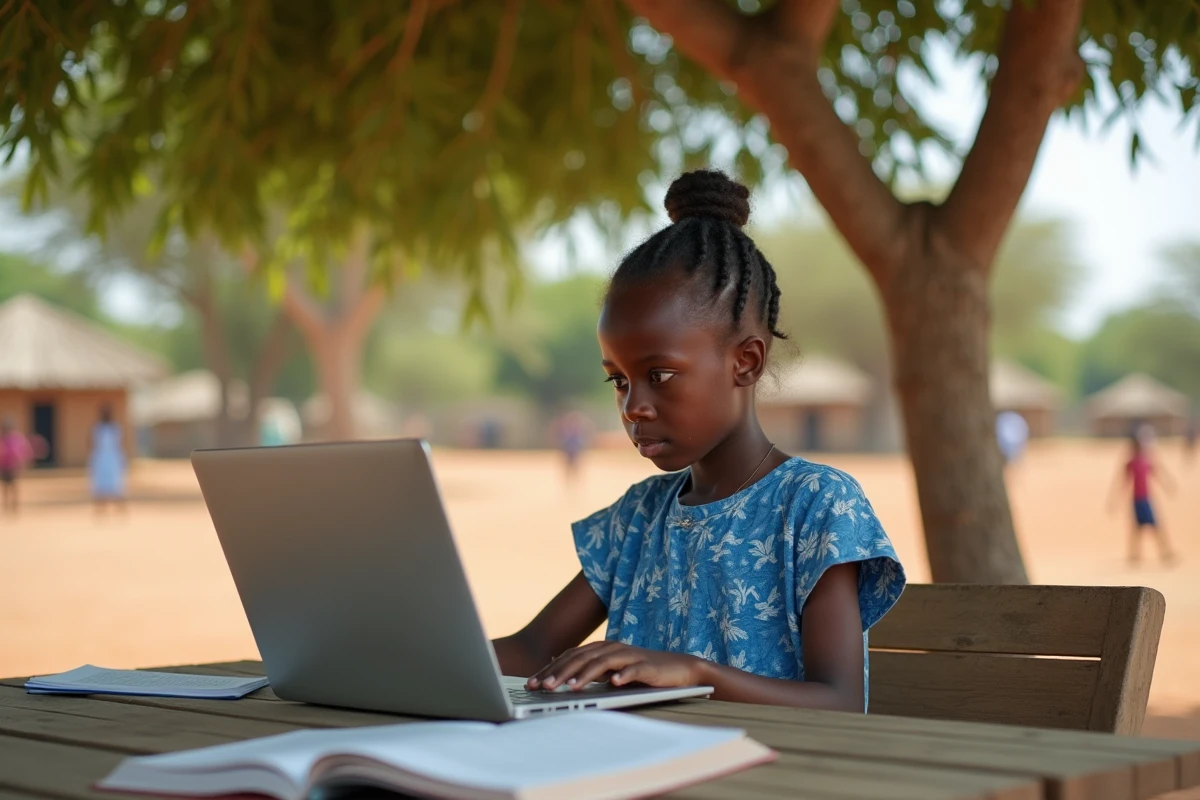
A figure that cuts short the discussions: Sub-Saharan Africa alone accounts for 20% of the world’s out-of-school children, even as it holds the record for global population growth. Public investments are increasing, but access to school and the quality of education remain privileges unevenly distributed, despite the multiplication of national reforms.
Between classrooms sometimes plunged into darkness due to lack of electricity and start-ups deploying cutting-edge artificial intelligence solutions, the contrast is striking. On one side, automated learning platforms; on the other, regions where illiteracy persists. This constant tension between technological innovations and local realities creates a new playing field for African education: complex, dynamic, and demanding.
Is artificial intelligence a lever for transformation in education in Africa?
The emergence of artificial intelligence in African schools disrupts established patterns. More than just a tool for automation or data analysis, AI is now capable of shaping personalized learning paths tailored to each student. For the continent’s educational systems, the promise is there: to detect difficulties, offer personalized content, and support students at their own pace. The digital transformation of education is finally taking concrete form.
Some players like Sankore are making significant strides by relying on algorithms capable of recommending relevant resources, even where internet connectivity remains rare or unstable. The relationship with knowledge is evolving: technology no longer merely copies old models; it demands a profound overhaul of pedagogy and redistributes roles between teachers and learners.
This ability to personalize teaching comes with particularly concrete challenges. Disparities in access to digital resources, teacher training, and lack of equipment do not disappear with a wave of a magic wand. The African Union encourages a collective response: pooling solutions, strengthening cooperation, and ensuring that digital transformation does not further widen the gap between the continent’s youth.
Digital innovations serving students and teachers: what concrete advances?
Digital technology is no longer just about dematerializing textbooks. It injects new practices and transforms the relationship to learning. Educational mobile applications are becoming daily companions for teachers and students, changing the dynamics in and out of the classroom.
Here’s how these tools are transforming the educational daily life:
- The development of digital educational resources, designed to adapt to local languages and contexts, offers an unprecedented opportunity for children from all backgrounds to feel concerned and represented.
- Online learning platforms open the door to remote learning, breaking the isolation of students far from urban centers and offering vibrant, updated, interactive content.
- Continuous teacher training relies on these same platforms, allowing for rapid dissemination of pedagogical innovations and skill development tailored to field needs.
In many countries, MOOCs and e-learning solutions are accompanied by intelligent assessment tools. Thanks to machine learning, students’ progress is closely monitored, difficulties identified, and learning paths adapted accordingly. This individualization aims to empower students and gradually eliminate inequalities in opportunity.
However, the success of these innovative technologies depends on their adoption. It is not enough to deploy tablets or applications: it is the teachers, faced with infrastructure constraints and the diversity of local situations, who turn them into real learning levers. It is in their hands that digital innovation proves, or does not prove, its effectiveness on the ground.

Between inspiring successes and persistent challenges: what African experiences reveal
African digital education is fueled by initiatives that go beyond theory. In Dakar, teachers are innovating with portable interactive boards, transforming their teaching methods. In Nairobi, schools connect students and teachers through collaborative platforms, abolishing the boundary between city and countryside. These examples are not exceptions: they reveal a movement of innovation that is already reaching millions of students.
Yet, the shadow of the digital divide still looms over much of Sub-Saharan Africa. Access to electricity or the internet remains uncertain in many areas, slowing the march towards truly inclusive education. According to the International Telecommunication Union, more than half of rural schools still lack reliable connectivity. The ambition to bridge the gaps in the educational system is confronted with these stubborn realities.
The obstacles are well identified:
- Many areas without stable access to electricity or networks
- Teacher training that is too irregular or incomplete
- Insufficient educational content aligned with local realities
In response to these challenges, a counteroffensive is being organized. Networks of teachers are pooling their knowledge on forums, translating content into local languages, sharing resources via mobile applications to circumvent traditional blockages. The African Union supports collaboration between governments, businesses, and communities, convinced that success will come through cooperation and the ability to invest for the long term. The digital transformation of African education is being written in these alliances and in the energy deployed to build responses rooted in the reality of each territory.
The next generation of African students will grow up between screens and blackboards, between the promise of universal access to knowledge and the hurdles of daily life. It remains to be seen whether technology will fulfill its promise: to open wide the doors of school, for all, everywhere.