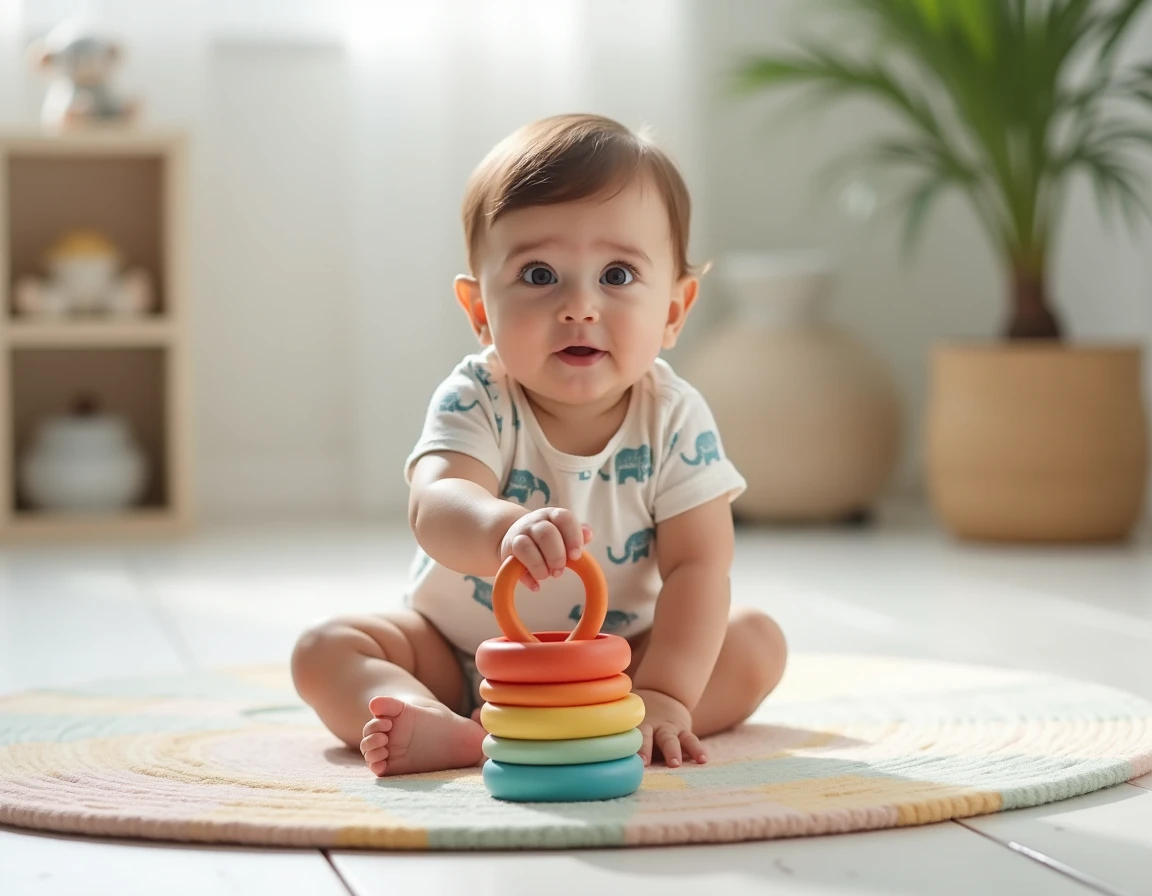
At 8 months, a baby grabs, shakes, brings objects to their mouth, sometimes crawls, and begins to understand that objects exist even when they disappear from their field of vision. This period of intense awakening drives many parents to multiply toys and stimuli. The question arises: which activities have a real effect on the motor, sensory, and social development of an 8-month-old baby, and how many are actually needed?
Awakening Activities at 8 Months: What Each Type Stimulates in Baby
Not all activities engage the same skills. The table below classifies eight common activities according to the developmental areas they primarily target in a child of this age.
| Activity | Gross Motor Skills | Fine Motor Skills | Sensory Awakening | Social Skills | Necessary Materials |
|---|---|---|---|---|---|
| Transferring objects between two bowls | – | Yes | Yes | – | Two bowls, large pasta or cubes |
| Peek-a-boo game with a cloth | – | Yes | – | Yes | A scarf or a dish towel |
| Pillow obstacle course on the floor | Yes | – | Yes | – | Pillows, blankets |
| Action rhyme (turn-taking) | – | Yes | – | Yes | None |
| Treasure basket (everyday objects) | – | Yes | Yes | – | Basket, sponge, wooden spoon, fabric |
| Crawling on grass | Yes | – | Yes | – | None |
| Passing an object “to you, to me” | – | Yes | – | Yes | A cube or a ball |
| Exploring an opaque fabric bag | – | Yes | Yes | – | Bag, three objects of varying textures |
Three out of eight activities require no specific materials. The other five use objects already present in most households. No commercial toy is essential to cover these four areas of development.
To delve deeper into these suggestions, you can discover Imazine’s tips on games suitable for this age.

Turn-Taking and Anticipation: The Underestimated Micro-Social Games at 8 Months
The majority of baby activity lists focus on motor skills and sensory experiences. The social aspect is often limited to peek-a-boo. Recent educational content highlights a more precise lever: short anticipation and turn-taking games support the emergence of social skills well before oral language.
The principle is simple. The parent offers an object saying “to you,” waits for the baby to take it, then opens their hand saying “to me.” This sequence of a few seconds engages joint attention, the ability to wait, and the understanding of alternation.
Why This Type of Interaction Works at This Age
At 8 months, a child begins to follow the adult’s gaze and anticipate a repetitive event. When the parent rolls a ball towards them, pausing before each throw, the baby shows visible anticipation: they lean forward, reach out, vocalize.
These micro-sequences of “to you, to me” lay the groundwork for language by establishing a structure of non-verbal dialogue. The baby learns that an interaction has a rhythm, a beginning, and an end, and that their action provokes a response.
In contrast, an electronic toy that reacts to every button press does not create this type of exchange. The response is instant, identical, and does not require waiting or adapting one’s action to a partner.
Sensory Awakening with Everyday Objects: The Revisited Treasure Basket
The treasure basket is a classic in awakening pedagogy. The initial concept is based on a principle that field professionals in play centers continue to promote: actively manipulated everyday objects are better than passively observed toys.
Creating an Effective Basket Without Buying Toys
The selection of objects matters more than their quantity. For an 8-month-old baby, the basket benefits from including contrasts in textures, weights, and temperatures:
- A wooden spoon and a metal spoon (wood is warm to the touch, metal is cold, and both produce different sounds when the child strikes them)
- A clean sponge and a piece of satin fabric (one resists pressure, the other slips between fingers)
- A small rigid container and a soft fabric bag (one retains its shape, the other deforms, which engages hand-eye coordination)
The parent’s role during this exploration is that of an observer. Naming what the baby touches (“it’s cold,” “it’s soft”) enriches the experience without directing it.
Fewer Toys, More Observation: Why “Doing Less” is Enough for Baby’s Development
The growing demand for “low-tech” and screen-free awakening games for those under 12 months reflects a shared observation from parent-baby workshops: the quantity of stimuli is not correlated with the quality of development.
An 8-month-old baby with two or three varied objects and an attentive adult explores longer and more deeply than a child surrounded by ten toys. Overabundance shortens attention time per object and reduces complex manipulations.
What Parental Observation Brings in Concrete Terms
Watching your baby play without intervening allows you to identify useful signals: what type of grasp they use (pinch, raking, whole palm), how long they maintain attention, and when they lose interest. These observations guide the choice of the next activities much better than an age-based guide.
Practicing two or three activities a day, varying the areas (one gross motor, one fine manipulation, one social game), meets the needs of a child this age. The rest of the time, free play on the floor with a few safe objects remains the most favorable setting for autonomous exploration.
- A few minutes of floor play several times a day engages motor skills more than a long session in a bouncer
- Alternating between a guided moment (action rhyme, turn-taking) and a free moment (treasure basket, floor exploration) avoids sensory overload
- Removing objects that the baby hasn’t looked at for several days and introducing just one new item reignites curiosity without creating distraction
The development of an 8-month-old baby is not measured by the number of activities offered. Three well-adjusted interactions, with simple materials and an observing parent, cover fine motor skills, coordination, sensory awakening, and early social skills. The rest is free time on the floor, and that’s enough.