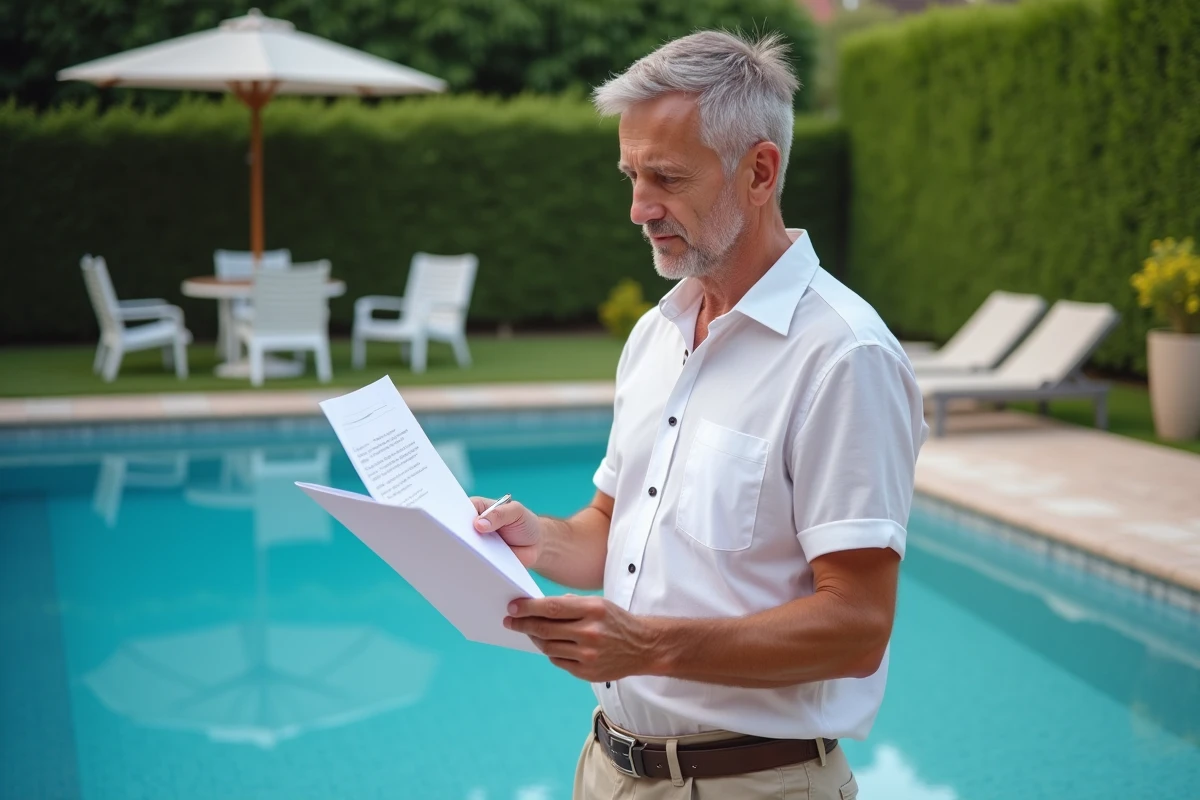
Since 2024, the rule is clear: any pool exceeding 10 m² must be reported within 90 days once the work is completed, under penalty of sanctions that can be significant. The amounts to be paid are not uniform: they fluctuate based on the municipality, the size of the pool, and local tax choices, so two neighbors, separated by a few kilometers, can end up with radically different bills.
Some temporary exemption measures exist, although they are rarely highlighted. They allow for a reduction in costs during the first few years following construction. But beware: a forgotten declaration or a calculation error can lead to inspections and tax back payments over several years, with sometimes hefty adjustments.
Understanding Pool Taxation in France: What Changes in 2024
Pool taxation reaches a new level in 2024. Until now, declaring your pool was almost an innocuous administrative gesture, sometimes ignored. That time is over. Any pool over 10 m² is now subject to a rigorous procedure, under the watchful eye of the tax authorities. Two main types of taxes are to be expected: the development tax, due upon construction, and the property tax, which is added each year to the property’s taxation.
For the development tax, the calculation is straightforward: multiply the surface area of the water body (excluding beaches and coping stones) by a national flat rate, then apply the specific rates decided by your municipality, your department, and sometimes your region. All fixed pools are concerned: in-ground, semi-in-ground, or above-ground, as long as they cannot be dismantled or moved from season to season.
Rates vary by territory. There are significant disparities between regions, cities, and rural areas, particularly between the provinces and Île-de-France. The amount of the pool tax therefore heavily depends on the location and type of installation. For precise and up-to-date figures, the page “Pool Tax: What is its Price in France? – Rêves de Déco” remains the reference resource, detailing the mechanisms and regional variations without falling into generalization.
Failing to declare exposes you to sanctions, sometimes retroactive. With aerial inspections and cross-referencing of cadastral data, it is difficult to slip through the cracks. It’s better to anticipate: declaration, calculation, and payment no longer allow for approximation. Pool taxation is now intended to be unambiguous, and every step counts.
How to Calculate and Declare the Amount of Tax for Your Pool
To estimate the development tax related to a pool, start by accurately measuring the surface area of the water body. In 2024, each square meter is valued at €258. Add to this the rate voted by your municipality, then that of the department, and possibly of the region: the total obtained sets the exact amount to be paid upon construction.
The property tax is added each year. Any pool fixed to the ground, whether in-ground, semi-in-ground, or above-ground but non-dismantleable, is considered a built dependency and included in the property’s tax base. The declaration must be made within 90 days following the completion of the work, using the form available in the “real estate” section of impots.gouv.fr.
Here are the main steps to follow to be compliant:
- Measure the exact surface area of the pool (in m²).
- Inquire about the applicable rates from your local tax office.
- Submit the pool declaration online, under “Declare a Construction.”
This process updates the calculation base for your local taxes. Any omission can lead to reassessment and penalties. In case of a particular configuration, extension, transformation, or atypical pool, the tax service will guide you. Here, improvisation has no place.
Frequently Asked Questions: Exemptions, Sanctions, and Local Particularities to Know
Many owners seek avenues for exemption for their pool. Some installations benefit from a partial exemption from property tax during the two years following the declaration of completion. This measure only applies to new pools, provided the declaration deadline is respected. After this period, the property tax applies fully, incorporating the added value to the structure.
The development tax, on the other hand, only sees reductions by express decision of the municipality. Some local authorities grant reductions, usually in exceptional situations or for collective projects. Therefore, it is essential to systematically consult local deliberations to check for specific measures.
Sanctions are a major point of concern. Failing to declare your pool exposes you to a tax reminder accompanied by a fine, calculated based on the undeclared surface area. Aerial inspections and cross-referencing of cadastral files allow tax authorities to identify many undeclared pools each year.
As for removable pools, they are exempt from property tax as long as they can be removed without construction work and are not left in place all year round. Once a structure is fixed, even above-ground, it falls within the scope of local taxes. A prior exchange with your local tax office can help avoid many surprises and adapt your approach to the regulations in force in your area.
Building a pool in 2024 means accepting to navigate a regulated, meticulous, yet predictable tax environment. It’s better to play the transparency card, as under the vigilant gaze of the tax authorities, every square meter of blue now counts double.