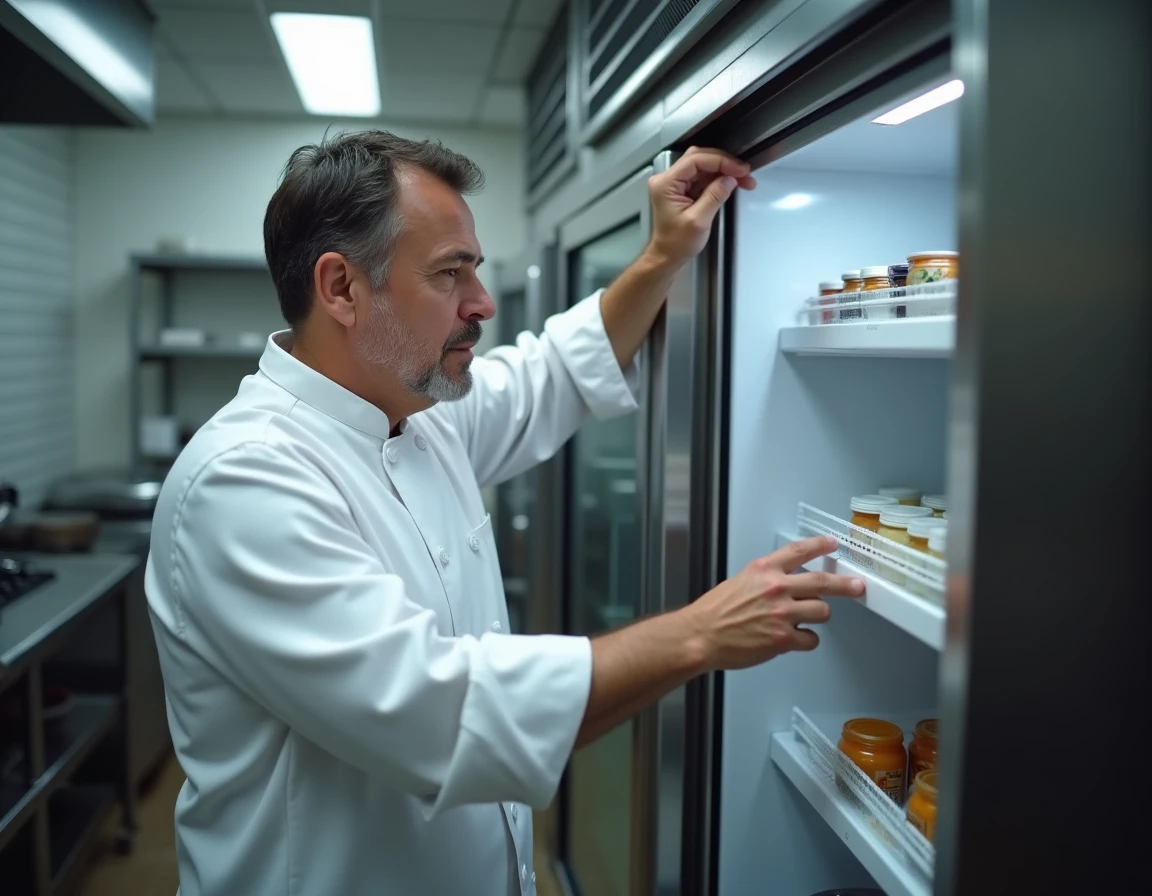
A professional refrigerator running continuously in a poorly ventilated kitchen, with a refrigerant soon to be banned by European regulations: this is the kind of situation that can undermine a business without warning. Choosing your professional refrigeration equipment means balancing the type of cooling, the refrigerant, the climate class, and the storage capacity, well before comparing prices.
Refrigerant and F-Gas regulation: the criterion that few professionals anticipate
Have you ever noticed the mention “R-404A” or “R290” on the nameplate of a refrigerated cabinet? This code designates the refrigerant used by the compressor. It directly affects the regulatory lifespan of your equipment.
Since the revision of the European F-Gas regulation (EU) 2024/573, refrigerants with high global warming potential like R-404A are on an accelerated phase-out trajectory. Buying equipment today that operates with this type of refrigerant exposes you to rising maintenance costs and regulatory obsolescence within a few years.
Manufacturers of refrigerated displays and furniture are massively shifting towards propane (R290) or transcritical CO₂. The catalogs available on megaref.net reflect this transition, with a growing share of models compatible with natural refrigerants. Choosing equipment with R290 or CO₂ protects your long-term investment.
Climate class and ambient temperature: adapting the equipment to your kitchen
A cold room installed in a basement at 18 °C does not operate at all like the same room in an open kitchen at 32 °C in summer. The climate class of refrigeration equipment defines the ambient temperature range in which it maintains its nominal performance.
Undersized equipment for its environment consumes more and cools less effectively. The compressor runs at full speed, wear accelerates, and breakdowns occur sooner.

Why does this parameter often take a back seat? Because the climate class is listed in small print on the technical sheet, after the volume and power. Always check it:
- Class 3 (SN): designed for an environment between 10 °C and 32 °C, suitable for most ventilated back kitchens
- Class 4 (ST): operates up to 38 °C, recommended for pastry labs or kitchens exposed to oven heat
- Class 5 (T): supports up to 43 °C, intended for particularly hot environments or geographical areas with a tropical climate
A restaurant with a cooking range near its refrigerated cabinet has every interest in aiming for at least class 4. The additional cost at purchase is recouped in energy consumption and longevity of the cooling unit.
Sizing the cooling unit: usable volume versus gross volume
The number displayed in liters on the product sheet corresponds to the gross volume. The usable volume, the one you actually use with your GN containers, shelves, and products, is always lower. The gap varies depending on the internal design of the equipment.
Thinking in terms of usable volume avoids under-sizing, a common mistake that leads to overloading a cold room or cabinet. An overfilled unit prevents air circulation around the products. The temperature rises in certain areas, compromising the cold chain.
To estimate the necessary capacity, start from your actual activity. A restaurant serving a hundred covers per service does not have the same needs as a butcher storing whole carcasses. Two questions are enough to frame the choice:
- What volume of fresh and frozen products do you handle in a typical day?
- How many days of stock do you want to keep in case of delayed delivery?
It’s better to plan for storage margin than to invest in a second unit six months later. A fill rate around two-thirds remains optimal for air circulation.
Ventilated cooling or static cooling: two preservation logics
Ventilated cooling propels cold air throughout the enclosure using a fan. The temperature is uniform, and the cooling recovery after door opening is quick. On the downside, moving air can dry out certain delicate products (pastries, leafy vegetables).
Static cooling works by natural convection. The air circulates slowly, preserving the moisture of the food. The downside: temperature variations between the top and bottom of the enclosure, sometimes by several degrees.
The choice between ventilated and static cooling primarily depends on the type of products stored. A kitchen that mainly handles meats and fish under film will benefit from ventilated cooling. A pastry lab or cheesemaker will often prefer static cooling to limit drying.

Connected supervision: managing refrigeration performance on a daily basis
Temperature remote monitoring systems (connected sensors, SMS or email alerts) are rapidly spreading in the food service and distribution sectors. Their benefits go beyond the simple convenience of remote consultation.
A sensor that continuously records temperature provides documentary proof in case of health inspections. It also detects deviations before they lead to breakdowns: a door left ajar, abnormal frosting, a compressor extending its cycles.
IoT supervision transforms reactive maintenance into preventive maintenance. Instead of intervening after a breakdown, the technician acts on a weak signal. The cost of a connected sensor remains modest compared to the loss of goods or an emergency compressor replacement.
The choice of professional refrigeration equipment commits your business for several years. A refrigerant compliant with F-Gas regulation, a climate class suitable for your work environment, sizing calculated based on your actual activity, and a reliable supervision system form a solid technical foundation. Each parameter taken in isolation may seem secondary, but it is their combination that determines the performance and profitability of refrigeration in your establishment.