
On a construction site for individual houses or extensions, the mason often asks the same question right from the structural phase: which concrete block should be ordered? The answer depends less on the name given to it than on the technical constraints of the project, the chosen insulation plan, and the available budget for masonry.
Concrete block and RE2020: what the regulations change on site
Since the implementation of RE2020 for new houses, energy performance requirements have altered the industrial offering of concrete blocks. Manufacturers now offer rectified blocks, insulated formwork blocks, or thermal break blocks to meet regulatory thresholds without resorting to very thick insulation layers.
In practice, one no longer chooses a concrete block solely based on its mechanical resistance. The thermal study office imposes a level of overall performance for the finished wall (block + insulation + coating), and this calculation guides the order. A standard hollow block remains compatible with RE2020, but it will require compensating with more substantial external or internal insulation.
When hesitating between concrete blocks or agglomerates for construction, the distinction is primarily terminological. Both terms refer to the same basic product, a molded block made of aggregate concrete. The real differences lie among the families of blocks: standard hollow, solid, insulating, or formwork.
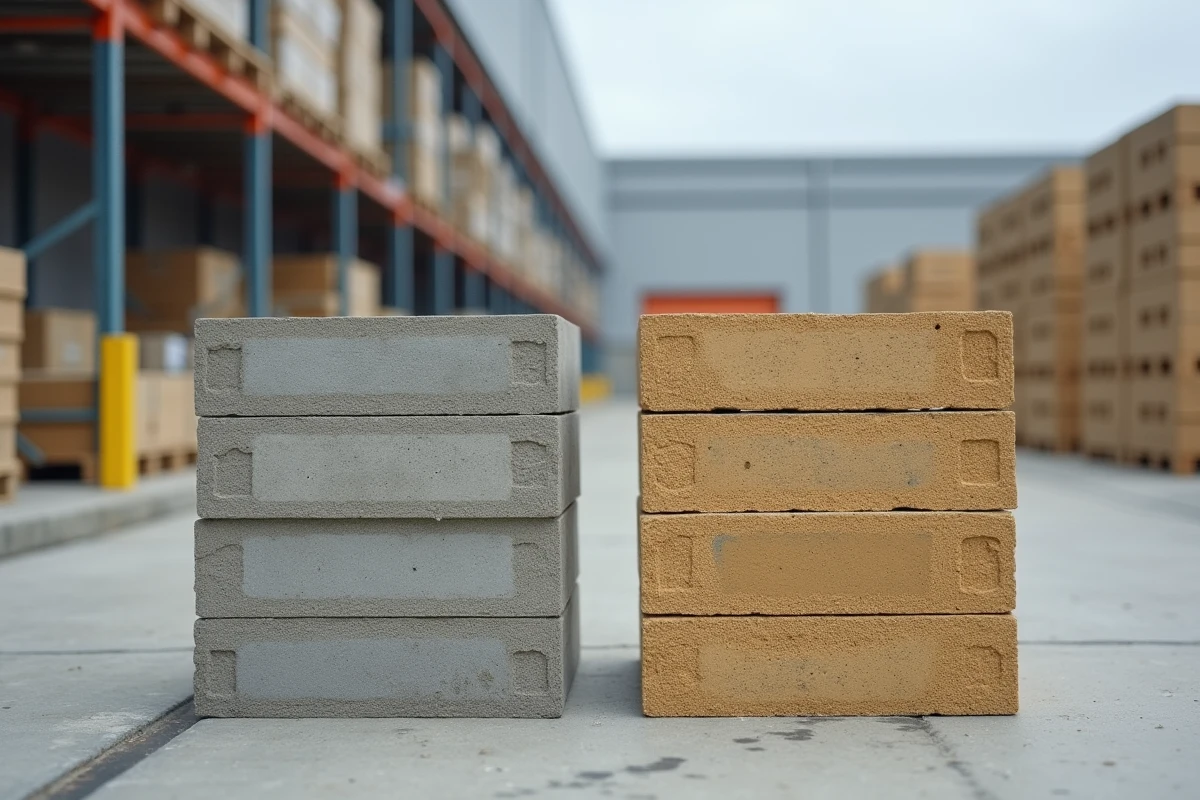
Low carbon concrete blocks: a selection criterion for labeled projects
Recent site feedback shows that low carbon blocks are installed exactly like standard concrete blocks. There is no change in methodology for masons, nor any additional training required. The difference occurs upstream, during manufacturing, with cements that have a reduced carbon footprint.
This criterion is particularly important for projects subject to environmental labels (HQE, Regional Sustainable Buildings). For a standard construction without a label, the additional cost of low carbon blocks is discussed on a case-by-case basis with the supplier. Feedback on this point varies by region and order volumes.
Why it matters from the estimate
A project owner aiming for a label must include the carbon footprint of the structural work in their overall calculation. Choosing a low carbon block from the outset avoids the need to compensate elsewhere (more efficient joinery, more expensive technical equipment). This leads to greater project coherence rather than successive patches.
Hollow, solid, or insulating blocks: which block for which wall
The choice of block type directly depends on the structural use of the wall. Confusing the families of blocks is like choosing a screw without knowing the thickness of the support.
- Standard hollow block: the most common for load-bearing walls and partition walls. Lightweight to handle, compatible with all external insulation systems, it remains the default choice on most individual house sites.
- Solid block: reserved for structures requiring high mechanical resistance (retaining walls, buried footings, pillars). Heavier and more expensive, it is not justified for a standard wall.
- Insulating block (with thermal breaks or inserts): designed to limit thermal bridges without thickening the applied insulation. Relevant when the ground footprint is constrained or when the project aims for thermal performance above the regulatory minimum.
- Formwork block: used to pour reinforced concrete inside. It is mainly found in foundations, basements, or for swimming pool walls. It is not a standard filling block.

Aggregates and supply: a site constraint to anticipate
The restrictions on quarry operations in France are gradually changing the availability and price of aggregates, the raw material for concrete blocks. In certain geographical areas, delivery times have increased in recent years.
For a modest-sized construction site (extension, garage, fence wall), this pressure on aggregates has a limited impact. For a complete house project, checking the availability of blocks with the local supplier before finalizing the schedule avoids costly project delays.
Adapting the choice to the regional supplier
Not all manufacturers offer the same range. A supplier in Brittany will not have the same insulating blocks as a depot in the Rhône Valley. Rather than specifying a precise block in the technical description, one can ask the mason which references they usually use and check their compatibility with the thermal study.
Concrete block selection criteria for a construction project
The final choice rarely comes down to a single parameter. Three criteria allow for a decisive choice:
- The nature of the wall (load-bearing, partition, footing, fence) determines the block family. A load-bearing wall in R+1 has different constraints than a garden wall.
- The planned insulation system: external thermal insulation (ITE) makes the block choice less critical thermally, as performance is ensured by the insulating envelope. With internal insulation (ITI), an insulating block can reduce the total thickness of the finished wall.
- The overall budget for masonry + insulation: comparing the cost of the block alone makes no sense without including the cost of the associated insulation. A cheaper standard block that requires thicker insulation may end up costing the same as an insulating block installed with a light complement.
The construction vocabulary perpetuates confusion between agglomerates and concrete blocks, but the real decision is made between families of blocks, depending on the wall to be built and the desired thermal performance level. Asking the thermal study office before ordering remains the most reliable reflex to avoid additional costs or non-compliance upon delivery.