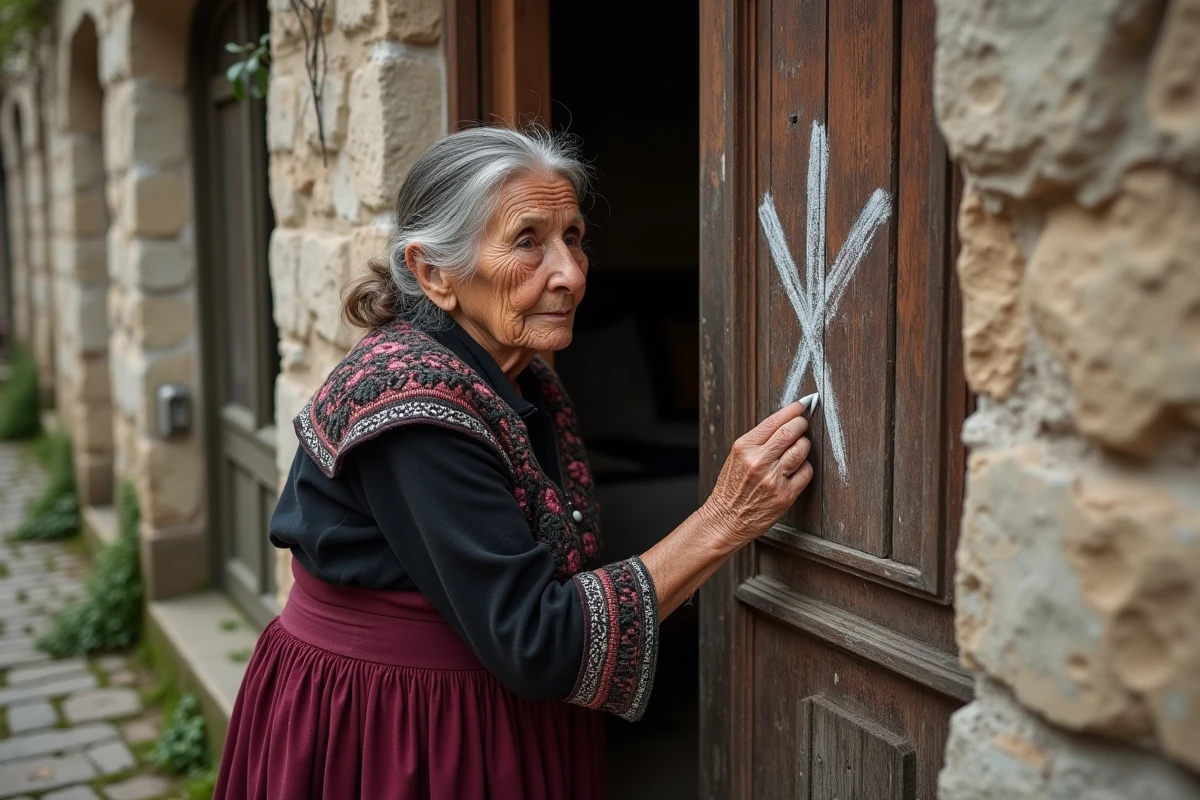
The expression “gypsy sign in front of the house” refers, in common language, to discreet markings (chalk crosses, stones, lines on a gate) interpreted as codes for identifying targets before a burglary. This formulation, which has gone viral on social media and neighborhood groups, systematically associates these marks with gypsy or Romani culture, without this attribution being based on documented facts.
The phenomenon deserves a two-part examination: first, to understand what this expression reveals about the society that uses it, and then to distinguish actual burglary practices from superstitions projected onto a community.
Viral rumor and racial biases behind “gypsy signs”
Online rumor monitoring organizations classify “gypsy signs in front of the house” as a textbook case of viral rumor. The pattern repeats: a photo of a cross or stone, often taken in another country, circulates on Facebook, TikTok, or a local neighborhood group, accompanied by alarmist text attributing these marks to “gypsy tribes.”
This recycling of images works because it relies on a pre-existing imaginary. The legitimate fear of burglary attaches itself to old stereotypes associating itinerant populations with theft. The result is a shortcut where any unidentified sign on a gate becomes proof of an ethnically characterized threat.
Since the early 2020s, Romani and gypsy representatives, supported by associations defending travelers, have publicly denounced this amalgamation. Their main argument: these codes come from opportunistic criminal environments, without any claimed Romani or gypsy cultural roots. Attributing these practices to an entire community is more a matter of prejudice than criminological analysis.
An in-depth article on gypsy superstitions and symbols details this distinction between documented criminal practices and popular beliefs projected onto an ethnic group.

Burglary identification codes: origin and real functioning
The marks left in front of homes do exist in certain criminal operating methods. Law enforcement regularly documents them, but attributes them to organized networks, not to a culture or people.
The principle is simple: an individual spots a residence, assesses its vulnerability, and then leaves an indication for their accomplices. The symbols vary from one network to another and do not follow any universal code or cultural tradition.
- A cross may signal an easily accessible house in one network, and an alarm presence in another.
- A stone placed on a wall sometimes serves as a test: if it hasn’t moved after a few days, the residence is likely unoccupied.
- Colored lines on a mailbox may indicate the presence of a dog or the prolonged absence of the inhabitants.
The problem arises when these marks, whose meanings vary according to the criminal group, are presented online as a fixed dictionary attributed to the Gypsies. This rigid interpretation transforms a variable criminal tool into a fantasized folklore.
Real gypsy superstitions and confusion with markings
Romani culture has its own traditions and beliefs, like any culture. Some pertain to home protection, rites of passage, or lucky objects. No serious ethnological source describes an external marking system of others’ houses as a gypsy ritual.
The confusion arises from the overlap of two distinct realities: on one side, internal traditions of a community (related to family life, marriages, mourning); on the other, criminal practices with no ethnic link. Merging the two into the same expression reinforces a stereotype without illuminating either gypsy culture or burglary prevention.
This semantic fusion has concrete consequences. It fuels mistrust towards travelers living near a neighborhood and diverts attention from real security measures (lighting, locks, neighbor vigilance).
What ethnologists document
Research on Romani cultures focuses on family rituals, purity rules, musical practices, and forms of community organization. The marking of others’ houses does not appear in any ethnographic corpus as a gypsy cultural practice.
The expression “gypsy superstition” applied to these signs thus constitutes a projection: the majority society attributes to a minority group practices that actually fall under organized delinquency, independent of any ethnic origin.

Sign in front of the house: what to do concretely in the face of a suspicious mark
Rather than seeking an online decoder for “gypsy symbols,” a pragmatic approach remains more effective.
- Photograph the mark before removing it, to have an element to show law enforcement if necessary.
- Check the state of access points (locks, shutters, outdoor lighting) in the following days.
- Notify immediate neighbors: a local vigilance network works better than any interpretation grid found on social media.
- Report the situation to the local gendarmerie or police station, which can confirm or deny the presence of suspicious activity in the area.
The majority of marks found in front of houses have a mundane explanation: children’s play, delivery marker, signs of work. Systematic attribution to an ethnic group does not better protect a residence; it only perpetuates an unfounded climate of suspicion.
The issue lies less in decoding symbols than in the ability to distinguish a real risk from a recycled rumor. Criminal identification marks exist, but their interpretation requires local context, not an imaginary ethnic repertoire shared on social media.