
Which technology segments have truly progressed in 2024, and which remain at the promise stage? Between generative AI embedded in consumer devices, new categories of PCs powered by neural chips, and announcements from Apple or Google regarding data privacy, this year’s high-tech trends are not just a list of gadgets. They reflect a concrete shift in how businesses and individuals handle artificial intelligence on a daily basis.
Local AI on smartphones and PCs: the 2024 approach comparison
The highlight of 2024 is not the generative AI itself, but where it runs. Three distinct strategies are emerging among the major players, and their implications for users differ radically.
| Player | Technology | Execution | Announced Priority |
|---|---|---|---|
| Microsoft / Qualcomm | Copilot+ PC with NPU | On-device (laptop) | Speed and data privacy |
| Gemini Nano on Pixel | On-device (smartphone) | Summary and text generation without server | |
| Apple | Apple Intelligence on Apple Silicon | On-device primarily, cloud as fallback | Privacy and hybrid processing |
This table highlights a convergence: generative AI is migrating from the cloud to the local device. Google introduced Gemini Nano at Google I/O 2024 to execute article summaries and text generation directly on certain Pixel smartphones, without sending data to its servers.
Apple announced in June 2024 a set of generative functions (summary, rewriting, image creation) primarily running on recent Apple Silicon chips. Cloud usage only comes into play when the task exceeds local capacity, through a system that Apple presents as privacy-friendly.
To follow Geek Newz’s high-tech news on these topics, the underlying trend remains the same: the processing of personal data is physically getting closer to the user, which alters the trade-offs between performance and privacy.
Copilot+ PC: a new hardware category to evaluate
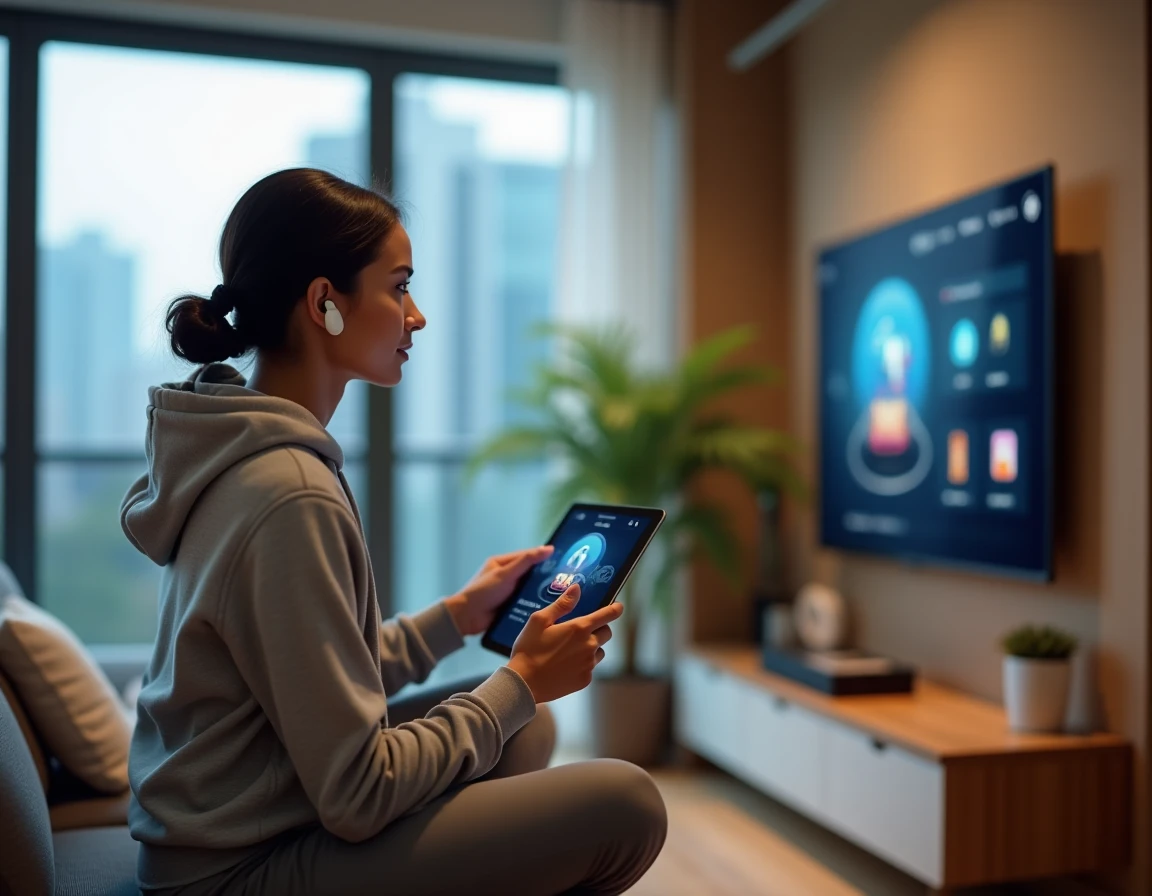
Since spring 2024, Microsoft and several manufacturers (Dell, Lenovo, Asus, HP) have been marketing Copilot+ PCs integrating chips with NPU (Neural Processing Unit). This neural processing unit, dedicated to artificial intelligence tasks, allows for generative models to run directly on the laptop.
The announcement was formalized at the Microsoft Build 2024 conference, in partnership with Qualcomm. The positioning is based on two arguments: reducing latency compared to cloud processing and not transmitting sensitive data to remote servers.
What the NPU changes for the user
The difference with a standard PC is not measured in raw power, but in the ability to process AI queries without a constant connection. The use cases highlighted by manufacturers include:
- Transcription and summarization of video meetings in real-time, without third-party cloud services
- Semiotic search in local files (photos, documents, emails) via natural language queries
- Image generation or editing directly within office applications
This “AI PC” category is already structuring the 2024-2025 ranges of major laptop manufacturers. It represents a change in architecture, not just marketing.
High-tech innovations beyond AI: connected objects and health
Artificial intelligence captures the majority of attention, but other technological innovations presented at CES 2024 in Las Vegas deserve examination. The show highlighted categories that alter the relationship between technology and daily life.
AI-powered home robots constitute an expanding segment. Their operation relies on computer vision models that allow them to navigate in a changing environment, far from the pre-programmed paths of previous generations.
The BeamO device, presented by Withings, offers a home health assessment combining several measurements (temperature, auscultation, oximetry) in a single connected device. This type of product illustrates the convergence between health and high-tech, an area that companies in the sector are heavily investing in.
Transparent screens and gesture interfaces
LG showcased a transparent OLED television aimed at the general public at CES 2024. Beyond the visual effect, the interest lies in the envisioned uses: heads-up display integrated into furniture, interactive showcase for retail, semi-transparent space separation in offices.
Contactless interfaces are also progressing. Several prototypes allow for device control through gestures captured via camera, without any physical contact. Gesture replaces touch in certain professional contexts where hygiene or sterility are priorities (health, food industry).
Personal data and generative AI: the real trade-off of 2024
The shift of AI to the local device is not just a technical feat. It responds to a growing tension around the management of personal data by technology companies.
Apple has explicitly positioned Apple Intelligence as a response to privacy concerns, limiting cloud reliance to cases where local processing proves insufficient. Google adopts a similar logic with Gemini Nano, eliminating the transmission of certain queries to its servers.
In contrast, the business model of these players has historically relied on data collection and exploitation. Local AI creates a structural tension between privacy and monetization. The announcements of 2024 show that manufacturers are attempting to resolve this contradiction through hardware architecture rather than solely through software policy.
The technological trends of 2024 stand out from previous years by a physical shift in processing. AI is no longer confined to data centers: it is embedded in the chip of the phone and laptop. This movement, simultaneously driven by Apple, Google, and Microsoft with different approaches, redefines what it means to own a device capable of generating, summarizing, and analyzing without relying on a constant connection.