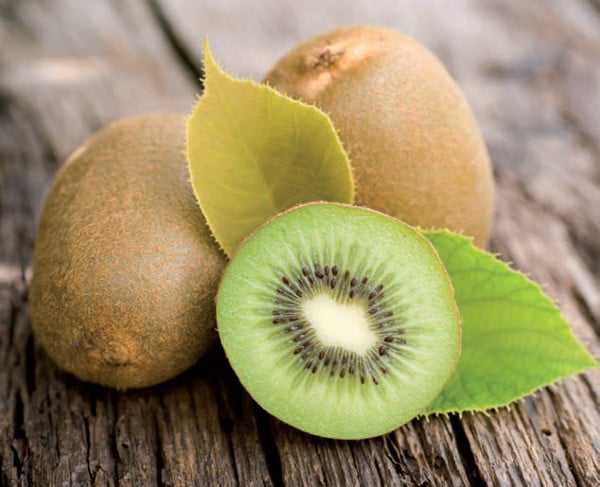
Arrived and spread in Italy since the 1980s, the kiwi or actinidia (Actinidia chinensis) has settled very well in Italy, especially in Lazio and Veneto where it is produced on a large scale. In the garden, it is a valuable plant both for its beauty and for its fruit production in autumn.
All species of actinidia
The genus Actinidia is part of the family Actinidiaceae and includes about 40 species, almost all native to the subtropical and temperate regions of Southeast Asia: Nepal, China, Korea, Manchuria, etc. Among these species, we find some that are decorative and elegant for their foliage and growth habit, and others that are more productive, in terms of quantity and quality. The genus Actinidia can be divided into two sections:
1. Stellate, which includes Actinidia chinensis, the main species used for fruit production;
2. Leiocarpes, including Actinidia kolomikta and A. arguta, the main ornamental species.
The fruits of A. chinensis can be divided into three types according to the color of the pulp:
1. green kiwi, very widespread; the fruits have dark brown skin with small hairs and the flesh is bright green, with small black seeds arranged in a radiating pattern around the center of the fruit, the shape is oval or potato-like;
2. golden kiwi, elongated shape, yellow flesh, and smooth skin.
3. red-fleshed kiwi with brick skin, diffusion type.
Actinidia chinensis
Introduced to Europe, specifically in France in 1897, and in 1904 in New Zealand, it was cultivated for the first time. There are many varieties, making it possible today not only to adapt the species to different climatic zones but also to produce fruits with different characteristics in color, flavor, texture, and also nutrient content. Among the most popular cultivars, we mention Hayward, Abbot, Allison, Bruno, Katiuscia, Top star, Tomuri, Matua, Autari, M3.
For productive purposes, it is multiplied through seeds (to obtain rootstocks) and for genetic improvement, by cutting, especially in central and northern Italy, as it is the fastest method to regenerate plants damaged by cold, and by grafting particularly in southern Italy.
Actinidia kolomikta
Actinidia kolomikta is an ornamental species, widely used to cover bare walls or old tree trunks that are now dead.
Its main feature is to produce colored leaves, cream-white and pink, fragrant flowers.
This species also prefers a normal, well-drained soil. The flower is white and its flowering period is from June to July. It reaches a maximum height of 5 m; to form fully covered pergolas, it should be planted with a density of 1 seedling per m² (of pergola to cover). In colder positions, winter protection is recommended at the collar and on part of the tree. You can use straw and jute bags to wrap the wood until the end of winter.
Growing Actinidia chinensis
- Actinidia chinensis, better known as kiwi, adapts to all climates and tolerates both extreme heat and frost. The fruits, however, are sensitive to autumn frosts, while the shoots are vulnerable to spring frosts. It is a plant particularly sensitive to wind: it is therefore advisable to place the plants in low-wind areas or use special windbreaks. An ideal plant for the plain, where it grows quickly, the kiwi dislikes sea wind.
- It is advisable to avoid areas affected in summer by dry and strong winds and try to maintain a high ambient humidity, with mulching of the soil around the roots and frequent spraying of water even on the foliage. They are particularly useful in summer even to “cool” the soil and vegetation, otherwise, there is a risk of seeing burns on the foliage that loses its turgid beauty, one of the excellent reasons to give yourself this generous plant, excellent even in hanging gardens: its root system, in fact, remains quite shallow, thin, and thickly branched, and for this reason, it is particularly sensitive to drought and heat.
- Plant kiwi in autumn or late winter, by purchasing seedlings from a reputable nursery that can provide you with useful advice related to the climatic trends of your area. Late frosts are particularly harmful to newborn shoots at the end of winter: if there is this risk, plant the specimens in a south-facing and well-sunny position to minimize the persistence of frost.
- Being a climbing shrub, it is advisable to reproduce it on a support, as in the case of vines. The plants should not be placed too deeply, and the grafting collar should remain above soil level. Set up a robust structure of posts and wires to support the vegetation or use a pergola with a strong enough support to bear the weight of the vegetation. For an aesthetic and productive result, it is advisable to have at least 3 female specimens plus one male specimen to be able to climb on the pergola.
- In the garden and on the terrace, you can grow it on pergolas and barbecues. Be careful: The growth is rapid and impetuous, do not place the kiwi next to other delicate vines, such as clematis, as it risks suffocating them quickly.
- The kiwi plant requires very abundant irrigation and that is why it is necessary to organize an ad hoc irrigation system.
- The cultivation should take place on a loose and deep soil, rich in organic matter and neutral pH. Ensure that it is not calcareous: in this case, improve it with peat and soil for azaleas or rhododendrons before planting, and prepare an irrigation system with filtration from limestone if you have “hard” water in your water supply. Ideally, have a well with neutral pH water.
- Regarding fertilization, it is advisable to distribute well-matured manure or stall manure at the end of autumn or late winter, every year; in spring and summer, no further fertilization is necessary.
- Fruits are formed on the branches of the year, and not on old wood; after harvesting, at the end of autumn or late winter, the branches that bore the fruits are removed by severely shortening them to a few buds. Do not prune late because otherwise there is a strong loss of sap: it is said that the plant “cries”.
- You can remove some of the leaves from the middle of summer to allow the fruits to be well exposed to the sun and promote early ripening.
- When it comes time for harvest, detach a bit of fruit and open it: if the fruits have already all the black seeds, the fruit is practically ripe. Fruits are harvested in mid-autumn, but in good weather, they can remain on the branches until January.
Diseases and pests of actinidia
Kiwis are damaged by physiopathology caused by frost, hail, wind, iron chlorosis, and by insect diseases such as Metcalfa pruinosa, Ceratitis capitata, which can severely damage the plant, the former by rubbing the plant organs and promoting the development of sooty mold, the latter causing significant damage to fruits. Do not forget also many mites like bacterial blight that causes root tumors, fungal attacks that cause root rot and gray mold. Moreover, among the problems encountered, it is useful to remember that there are different species responsible for allaplant damage.
Tag: https://www.lejardineur.net/comment-cultiver-un-kiwi/